



Capaver AkkordFleece Z120/130 K
Uncoated cellulose-polyester fleece for efficient restoration
of common interior substrates.


Field of Application
Capaver AkkordVlies Z130 K & Z150 K are closed-cell cellulose-polyester fibre fleeces, suitable to retard alligator cracking and for bridging small pores and shrinkage holes. Both fleece types provide for highly attractive, high-grade and individual wall surfaces, due to variations in texture, type, colour shade, gloss level and application technique of topcoats. In accordance with the expected degree of stress or desired visual appearance, the fleeces may easily be coated with suitable paints and efficient renovations are possible, due to individual needs.Material Properties
- Non itching, high skin-friendliness (compatibility).
- Highly masking the surface.
- Easy to renovate: Recoatable without any pre-treatment.
- Dimensionally stable, crack bridging (shrinkage and drying cracks).
Material Base / Vehicle
Cellulose-polyester fleeceTypes that can be delivered
| Product Name | Texture | Weight per m2 | Packaging/Roll Size |
| AkkordVlies Z130 K | smooth | Approx. 130 g | 50 m x approx. 0.75 m |
| AkkordVlies Z150 K | smooth | Approx. 150 g | 50 m x approx. 0.75 m |
Packaging/Package Size
Selectable unit: Four rolls per carton.Storage
Keep the products in a dry place.
Technical Data
- Water vapour permeability (sd-value): 0.03 m = Class V1 (high)
Tested with approx. 200 g/m2 of CapaColl GK on AkkordVlies Z150 K without any further coating.
Supplementary Product
- Capaver CapaColl RF
- Capaver CapaColl VK
- Capaver CapaColl GK
- Caparol interior paints
Note
Dynamic building cracks cannot be removed with Capadecor AkkordVlies Z130 K or Z150 K.In Germany: Please follow the corresponding BFS Data Sheets.
Suitability according to Technical Information No. 606 Definition of Application Areas
| Interior 1 | Interior 2 | Interior 3 | Exterior 1 | Exterior 2 |
| + | + | ○ | – | – |
| (–) inapplicable / (○) of limited suitability / (+) suitable | ||||
Substrates
Interior surfaces: Mineral plasters in mortar groups/classes PI (lime plaster), PII (lime-cement mortars), PIII (cement mortars), PIV (gypsum mortar and ready-mixed gypsum plaster), plasterboards/gypsum cardboards (drywalls), gypsum wallboards, concrete.Substrate Preparation
The substrate must always be solid, dry, sound/stable, clean, even and free from all substances that may prevent good adhesion.Follow Technical Information No. 650.
In Germany: Follow VOB, part C, DIN 18366, section 3.
Lower temperature limit for application and drying: +5 °C (product, substrate and ambient air).
Surfaces with colour contrast: One previously applied priming coat of Capadecor DecoGrund or Haftgrund.
Method of Application
Roller Application:- Apply CapaColl VK or CapaColl GK evenly with a roller (18 mm piles), but only for 1-2 lengths, depending on the temperature on site.
- Note: Agglomeration of adhesive (glue) must be avoided to achieve an even surface.
- A minimum of 3 workmen on the job is advisable.
- CapaColl VK can directly be applied to the wall with airless equipment.
- CapaColl GK should be diluted with 20 % of tap (potable) water, depending on the conditions on site.
- Do not apply excess material and provide for an even application to ensure good bonding.
- After having finished, the spray applied coat of glue should always be rolled over (use roller with
12 to 14 mm piles).
Wallpaper Bonding Equipment:
- CapaColl RF and CapaColl VK are eminently suitable for use with wallpaper bonding equipment.
- CapaColl GK must be diluted 20 % with tap (potable) water.
- Adjust the material feed of paper bonding unit (e.g. TapoFix) to 1 - 1.5 (do not exceed the maximum value).
- Soaking of fleece lengths must be avoided by minimised soaking times.
- Always place the fabrics running in one direction and not laterally reversed, to avoid differences of appearance in texture/pattern.
- Capaver fleeces should be bonded with butt joints (double seam cut is possible for technical fleeces).
- Provide for narrow butt joints, but the forming of bulges must be avoided to obtain a proper visual appearance.
- Press the bonded lengths void-free with sufficient pressure to the full surface using wallpaper scraper or pressure roller. Fix the edges and cut of the excess length with a wallpaper scraper.
Hint: For bonding Capaver fleeces on external vertical corners, the length must pass around it for minimum 10 cm. For non-vertical corners the fleece must be cut at the edges.
For renovation: Both fleece types are easily removable from walls in dry condition, when using CapaColl RF for bonding.
Surface Coating System
Intermediate Coat:The intermediate coat forms the basis to obtain a perfect finishing coat. The intermediate coat can only be applied when adhesive and fabric/fleece are completely dry, and should be tinted to match the
finishing coat in shade. Recommendation: Apply one filling intermediate coat of Capaver Gewebegrundierung before applying finishing coats of thin film paint, e.g. latex paint.
Finishing Coat:
Selection of suitable products for finishing coats is depending on the degree of expected loads and desired gloss level. See the following table. Always apply wet-on-wet (this applies also for trimmings).
| Load | Intermediate Coat | Finishing Coat | Gloss Level | ||
| Product | Work Steps | Product | Work Steps | ||
| NORMAL | CapaTrend Malerit E.L.F. Sylitol Bio-Innenfarbe | 1 | CapaTrend Malerit E.L.F. Sylitol Bio-Innenfarbe | 1 | MATT |
| NORMAL– MEDIUM | CapaMaXX MattLatex CapaSilan NespriSilan | 1 | CapaMaXX MattLatex CapaSilan NespriSilan | 1 | MATT |
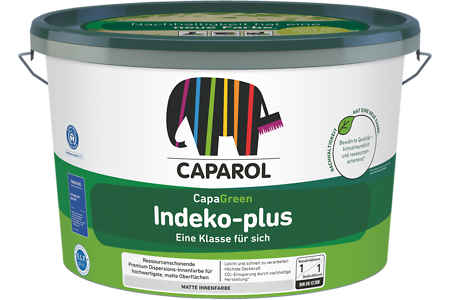
| Indeko-plus | 1 | Indeko-plus | 1 | MATT | |
| MEDIUM– HIGH | Amphibolin Latex Samt 10 | 1 | Amphibolin Latex Samt 10 | 1 | Silk matt |
| SeidenLatex | 1 | SeidenLatex | 1 | Silk gloss | |
| Amphibolin | 1–2 acc. to shade | Metallocryl Interior | 2 | GLOSS | |
| EffektGrund | 1–2 acc. to shade | CapaGold/CapaSilver | 2 | Silk gloss | |
| HIGH | PremiumClean | 1 | PremiumClean | 1 | Silk matt |
| Latex Satin 20 Latex 201 SG | 1 | Latex Satin 20 Latex 201 SG | 1 | Silk gloss | |
| Latex Gloss 60 | 1 | Latex Gloss 60 | 1 | GLOSS | |
| EXTREMELY HIGH | Disbopox 447 E.MI Wasserepoxid | 1 | Disbopox 447 E.MI Wasserepoxid | 1 | Silk gloss |
For further details please see the current product related Technical Information.
| Product | Loadability |
| CapaTrend Malerit E.L.F Sylitol Bio-Innenfarbe | - Wet scrub resistance Class 3 as per DIN EN 13300 |
| CapaMaXX MattLatex CapaSilan NespriSilan | - Wet scrub resistance Class 2 as per DIN EN 13300 - Resistant to aqueous disinfectants |
| Indeko-plus Amphibolin Latex Samt 10 SeidenLatex PremiumClean Latex Satin 20 Latex 201 SG Latex Gloss 60 Metallocryl Interior CapaGold✱/CapaSilver✱ | - Wet scrub resistance Class 1 as per DIN EN 13300 - Resistant to aqueous disinfectants |
| Disbopox 447 E.MI Wasserepoxid | - Wet scrub resistance Class 1 as per DIN EN 13300 - Resistant to aqueous disinfectants - Highly scratch- and shock-resistant - Chemical-resistant - Decontaminable as per DIN 25415 |
Drying/Drying Time
Allow bonded lengths to dry thoroughly before any further coating.Note
Always place the fleeces running in one direction and not laterally reversed, to avoid differences of appearance in texture/pattern. Only product of same batch can be used for covering seamless surfaces.Capaver wall coverings are thoroughly inspected by the manufacturer. In exceptional cases isolated production related weaving faults may occur. These faults are marked at the trimmed edges and correspondingly compensated. They do not entitle to any objection.
While cutting the fabrics, ascertain whether there are no weaving faults.
On principle the interior side of a roll has to be bonded to the wall. The outer side of the roll is the visible face.
In case of complaint the label with batch and product numbers must be kept ready (see original carton). Claims based on material faults cannot be objected after the application of more than 10 fabric lengths.
German Certificates
- Flame-retardancy according to German standard DIN 4102, B1
- Non-combustibility according to German standard DIN 4102, A2
- Decontaminatibility in combination with Disbopox 447 E.MI Wasserepoxid
| Fire behaviour classification associated with Capaver AkkordVlies Z 150 / 130 K | |
| Coating | Reaction to Fire: Class |
| CapaTrend | A2 |
| Malerit E.L.F. | A2 |
| CapaMaXX | A2 |
| MattLatex | A2 |
| Indeko-plus | A2 |
| CapaSilan | A2 |
| Sylitol Bio-Innenfarbe | A2 |
| Latex Samt 10 | A2 |
| Latex Satin 20 | A2 |
| Latex Gloss 60 | A2 |
| Amphibolin E.L.F. | A2 |
| Nespri®Silan | B1 |
| SeidenLatex | B1 |
| SG201 | B1 |
| PremiumClean | B1 |
| Disbopox 447 E.MI Wasserepoxid | B1 |
German test certificates for the corresponding products are available at www.caparol.de
Disposal
Materials and all related packaging must be disposed of in a safe way in accordance with the full requirements of the local authorities. Particular attention should be made to removing wastage from site in compliance with standard construction site procedures.
In Germany: Dispose Capaver AkkordVlies Z130/150 K as construction site waste.
Customer Service Centre
Tel.: +49 6154 71-71710Fax: +49 6154 71-71711
e-mail: kundenservicecenter@caparol.de
International Distribution: Please see www.caparol.com